 Accessible Home Hub
WORLDWIDE PLANNING · CONDITION ROADMAP
Stroke recovery and one-sided weakness: home planning
Prepare home-access and everyday-task questions with the rehabilitation team before discharge and as recovery changes.
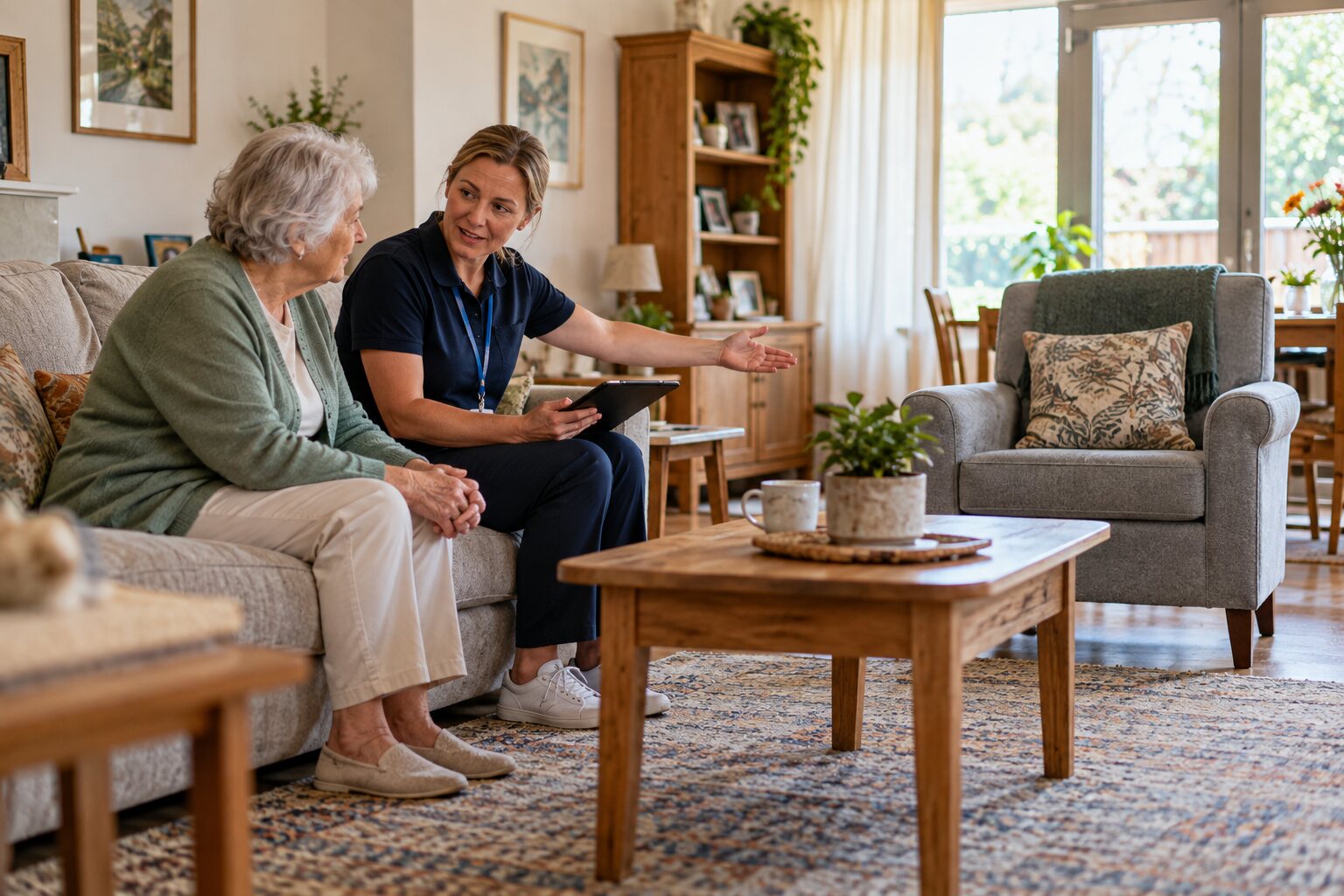
Plan around the person’s assessed abilities, goals and actual equipment. This guide prepares questions for the care team; it does not prescribe treatment, transfer techniques or installation dimensions.
Start with a home assessment and personal goals
A stroke can affect movement, sensation, balance, fatigue and thinking in different combinations. One-sided weakness and paralysis are not the same, and neither alone defines the right home layout.
Ask the rehabilitation team to assess the actual home, routines, equipment and available assistance. Agree essential arrangements before discharge and a follow-up after changes.
Plan bathing and toileting around assessed transfers
Ask the occupational therapist to observe the task and recommend the support, seating, reach and helper space needed. Grab bars should not be placed according to a fixed stronger-side rule; the transfer method, balance, perception and room arrangement all matter.
Trial any bench or seat and confirm its fit, rated use, fixing and assistance requirements. A showerhead slide bar is not a support rail unless explicitly designed and installed for that purpose.
Trial everyday tasks and equipment
Discuss meal preparation, carrying items and operating controls. One-handed tools, stabilising boards or adapted handles may be options to trial with the therapist, rather than a shopping list suitable for every survivor.
Check hot-liquid handling, sharp-tool risks, sensation, attention and fatigue. For shelves or controls, test the person’s reach and operation with the actual load. Voice control may be unsuitable if speech or language is affected; provide an accessible alternative.
Review routes, stairs and perception
Record clear passageways, turns and transitions with the actual mobility aid. Ask whether stairs are appropriate and what rail arrangements and training are needed. Agree an alternative route or ground-floor arrangement if required.
If the team identifies spatial neglect or visual difficulties, ask for individual strategies and a home review. Do not assume warning tape alone will resolve a perception or attention problem.
Plan ahead and agree review points
Ask the care team which changes may take time to assess, fund, deliver or install. Keep a current plan and a next-stage plan, with a named contact and review date. Revisit the plan after a change in everyday tasks, equipment or available assistance; progression is individual.
- Now: record essential routes, current difficulties and an agreed temporary arrangement.
- Before ordering: trial controls and equipment where possible; ask about loans, rental, servicing, returns and who provides training.
- At each review: check access, communication, backup arrangements and whether the resident’s priorities have changed.
Plan the return-home discussion · Record controls and backup access · Find local assessment and support routes.
Sources and further reading
Sources reviewed 7 October 2026. This is a planning guide, not a personalised rehabilitation programme.
Plan together
For residents and families
Record which tasks are difficult, when difficulty occurs and what the person wants to do independently. Take the record to the assessment and agree who will review changes.
For contractors and design professionals
Work from an assessed brief. Check equipment compatibility, supporting structure, manufacturer instructions and local requirements before installation.
Turn this guide into a plan
Choose the next step that fits your project. These tools help prepare a discussion; they do not replace an individual assessment.
Frequently asked questions
Is there a universal grab-bar position after a stroke?
No. Ask the rehabilitation team to assess the transfer, abilities, equipment and room before specifying rails or seating.