 Accessible Home Hub
FUNDING GUIDE · UK · US · CANADA · AUSTRALIA
Bathroom modifications for seniors: funding by country
Funding may be available for bathroom changes that address an older person’s access or care needs. Start with your country’s assessment or assistance route, describe the bathing or toileting difficulty, and confirm which work and costs qualify. Being a senior does not by itself establish approval.
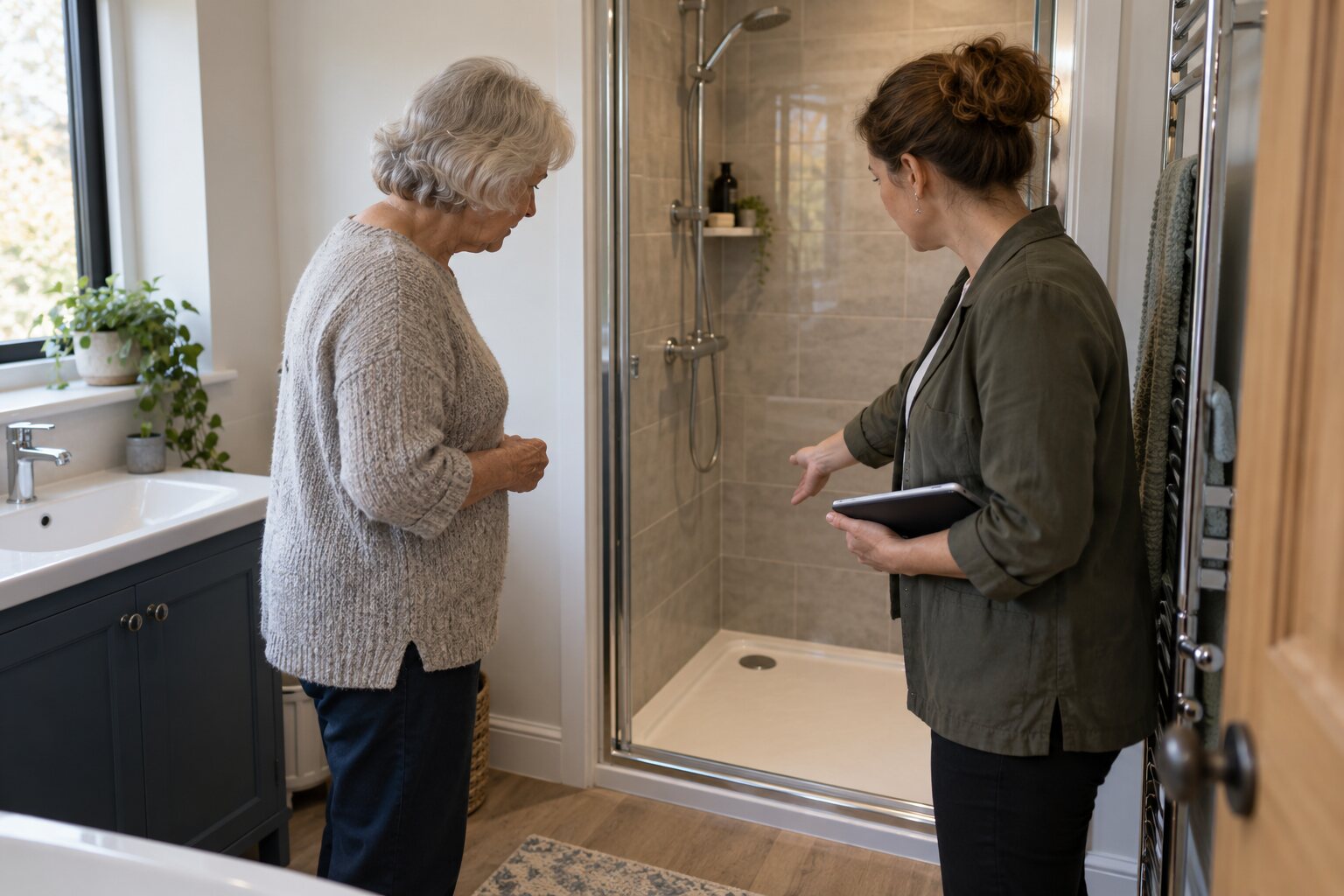
Where can I get help paying for bathroom adaptations?
A grant, an assessed service, a rebate, a loan and a tax credit affect the budget differently. Ask who authorises the work, who pays the installer and whether you must pay first. This is a selected guide to four countries, with local checks for readers elsewhere.
| Location | Routes to investigate | First question |
|---|---|---|
| United Kingdom | Disabled Facilities Grants and the appropriate nation’s adaptations service. | Who assesses my needs and approves the bathroom scope in my area? |
| United States | State Medicaid services, eligible VA benefits, rural and local housing assistance. | Which programme fits my circumstances, home and proposed work? |
| Canada | Home Accessibility Tax Credit and separate provincial or local assistance. | Is the help a later tax reduction or a payment towards approved work? |
| Australia | My Aged Care assessment and the relevant home-adjustment programme. | Which prescribed modifications, allocation and contribution have been agreed? |
Could funding cover a bath-to-shower conversion or grab rails?
Official examples include level-access showers in the UK, roll-in showers and accessible sinks under VA HISA, and prescribed shower changes and grab rails in Australian aged care. The proposed work still needs to meet the particular programme’s conditions. A product advertised as accessible does not establish funding eligibility.
Describe the task first
Record whether the difficulty is stepping over a bath edge, approaching the toilet, operating controls, reaching washing items or receiving assistance. Bring the resident’s preferred outcome and existing equipment to the discussion.
Separate essential work and extras
Ask which access changes and associated plumbing, waterproofing, floor work, fixing preparation and finishing are eligible. Mark cosmetic upgrades and optional extras separately in the quote.
Check equipment separately
A removable shower seat, a commode and a constructed level-access shower can follow different purchasing and funding rules. Ask for an answer for each item rather than treating the bathroom as one undifferentiated purchase.
Compare bathing equipment and installation questions. For a shower rail, record the enclosure, backing and approved-mounting questions.
United Kingdom: adaptation grants and nation-specific support
GOV.UK’s Disabled Facilities Grant guide includes age-related needs and examples such as grab rails and level-access showers. The work must meet the relevant needs and property tests. Starting before the application is approved can affect the grant; planning and building approvals are separate.
- England and Wales: start with the local council’s assessment and DFG route. Published grant limits and contributions differ by nation and financial circumstances.
- Northern Ireland: nidirect explains the Health and Social Care Trust and Housing Executive route, including occupational-therapy recommendations and approval before work.
- Scotland: contact the council’s social-work service for an assessment. Local support and the housing arrangement affect the available help.
Ask about means testing, the approved scope, owner consent and how the contractor will be paid. Conditional VAT relief is a separate invoice question, not proof that a grant has been awarded.
United States: Medicaid, veterans’ benefits and housing assistance
- Medicaid: states design HCBS waivers for particular populations and needs. Ask your state programme whether it covers environmental adaptations to the bathroom, what care-plan evidence is required and whether there is a waiting list. Use the VA and Medicaid planning guide.
- Veterans: VA’s Home Improvements and Structural Alterations (HISA) benefit lists medically necessary access to sanitary facilities, including roll-in showers, and bathroom sinks or counters. Ask the local VA Prosthetic and Sensory Aids Service about eligibility and remaining lifetime benefit. The application includes a VA-approved prescription, an itemised estimate and owner authorisation for renters.
- Eligible rural homeowners: USDA Section 504 offers distinct repair loans and health-and-safety grants. Grant applicants must be 62 or older, meet very-low-income and other conditions, own and occupy the eligible home, and be unable to obtain affordable credit elsewhere. Ask Rural Development whether the proposed bathroom hazard-removal work qualifies.
- Other local routes: USAGov directs readers to state and local housing departments. Ask about current repair or accessibility assistance, ownership rules, funding availability and any repayment conditions.
Does Social Security or SSI pay for bathroom modifications?
Keep monthly benefit payments separate from a bathroom-construction award. Social Security retirement benefits are monthly benefits based on the relevant work and eligibility rules. Supplemental Security Income (SSI) provides monthly payments subject to income, resource and other conditions. Receiving either does not, by itself, establish a separate grant to remodel a bathroom.
Your benefit income may be part of the household budget, but approval for an adaptation programme is a different question. Investigate the Medicaid, VA, USDA and local housing routes above for the actual project. If you receive SSI, ask SSA how changes in income, resources or assistance affect your benefits, and ask the relevant state programme about Medicaid support. Do not assume that an SSA benefit decision also authorises building work.
Does Medicare pay for a bathroom remodel?
Medicare Part B’s equipment benefit has its own ordering, eligibility and supplier rules. Equipment coverage does not establish approval to pay a builder for a bathroom conversion. If you have Medicare Advantage, ask the plan about the exact proposed modification, current benefit conditions and written authorisation. Read the US insurance questions.
Check any medical-expense tax deduction separately. A possible later deduction is not an upfront renovation grant.
Canada: tax relief and separate provincial assistance
CRA’s Home Accessibility Tax Credit guidance describes a non-refundable credit for qualifying lasting accessibility or safety renovations. Its reviewed filing page is for tax year 2025. A qualifying person can be 65 or older at year-end or eligible for the disability tax credit; the claimant, home and expenses must also qualify.
A non-refundable credit reduces tax otherwise payable. It does not provide a builder’s deposit or establish approval for every bathroom renovation. Use the dated HATC guide for 2025/2026 distinctions, claim records and provincial tax checks. Check the return year and any interaction with other claims before counting a saving.
A provincial example: British Columbia’s BC RAHA rebate
BC Housing’s rebate programme serves eligible BC households with limited income and assets and a permanent disability or loss of ability. Homeowners and tenants applying jointly with landlords have their own requirements. Some work needs a professional assessment. This is a British Columbia example, not a Canada-wide entitlement.
Check the relevant eligibility and approval rules before work; ask about current intake, eligible adaptations and any emergency exception. BC Housing’s pages state that content is current as of 22 September 2026. Readers in other provinces and territories should check their own housing or social-support authority.
Australia: assessed aged-care home adjustments
My Aged Care lists prescribed home adjustments such as grab rails, handheld showers and level-access showers through assessed programmes including CHSP, Support at Home and Transition Care. Ask which programme and service apply to the resident.
Under Support at Home’s AT-HM scheme, home modifications require an occupational therapist’s prescription. Approval, allocated funding and provider arrangements are separate steps; a participant contribution generally applies to modifications. Equipment and home-modification budgets are distinct.
Read the aged-care funding guide with its October 2026 rate table. Confirm the remaining allocation and complete bathroom scope rather than assuming the highest tier covers a whole remodel. For a disability-support route, read the separate NDIS notes.
Prepare your bathroom funding application
Use this original planning checklist to organise a conversation with the body deciding payment. Its published application requirements take priority.
- Describe the need. Record the bathing or toileting task, the resident’s goals, existing help and the part of the room that causes difficulty. Ask which clinical assessment, prescription or other evidence is needed.
- Confirm the home and applicant. Check ownership or tenancy, who can apply, owner consent, location and any income, asset or residency tests.
- Agree the eligible design. Ask which access changes and associated work can be included. Keep optional finishes and privately chosen extras identifiable.
- Obtain comparable itemised quotes. Include preparation, structural or floor work, plumbing, waterproofing, fixtures, labour, disposal, making good, taxes, permits and assessment/design fees where relevant. Mark allowances and exclusions.
- Record the decision and cash flow. Ask what is approved, who pays first, your contribution, the payment stages, the completion deadline and who approves variations. Check whether starting early affects eligibility.
- Keep a claim file. Retain decisions, scope versions, quotes, invoices, receipts, payment evidence and required completion checks. Confirm the rules before using the same cost for another benefit or tax claim.
Keep a pending grant or tax decision separate from confirmed money available for the project. Use the before-work insurance questions alongside the funding application.
If your country is not listed
Ask your local health or social-care service about a functional home assessment, and your housing authority about adaptation assistance. Ask the tax authority separately about relevant relief. Check local rules and published eligibility rather than applying another country’s funding limit to your home.
Explore the selected funding resource finder · Open the country notes.
Official sources and review scope
- GOV.UK: Disabled Facilities Grants, eligibility and payment and contribution guidance.
- nidirect: Northern Ireland grant route; mygov.scot: assessments and adaptations.
- Medicaid: HCBS waivers; VA: HISA; USDA: Section 504; USAGov: housing-assistance starting points.
- Medicare: equipment coverage.
- CRA: HATC, 2025 filing guidance; BC Housing: rebate overview and homeowner requirements.
- My Aged Care: home adjustments; Department of Health, Disability and Ageing: AT-HM scheme.
Sources reviewed 22 October 2026. These are selected routes, not a complete grant directory or an individual eligibility decision. Source years and regional limits matter; confirm current requirements, available funding and written approval with the responsible body.
Frequently asked questions
Can seniors get funding for bathroom modifications?
Some programmes can help with assessed accessibility, care or safety work. Location, needs, income, home and programme conditions matter; senior status alone does not establish eligibility. Start with the country-specific routes on this page.
Can funding cover a bath-to-shower conversion?
It may fit an approved access need, but the proposed design and costs must satisfy the particular programme. Ask which shower, plumbing, waterproofing, floor work and finishing costs are included, and keep cosmetic extras separate.
Does Medicare equipment coverage pay for a bathroom conversion?
Equipment coverage has its own rules and does not establish approval to pay for building work. Ask about each proposed item and, for Medicare Advantage, the actual plan benefit and written authorisation.
Can I start bathroom work while waiting for a grant decision?
Check the programme before committing or starting. Some schemes exclude work begun before approval, with limited exceptions. Tax relief follows separate rules and is not approval for a grant-funded construction project.
Will a home accessibility tax credit pay the installer upfront?
A tax credit or deduction is different from a grant or funded service. Check the relevant tax-year rules and payment timing; do not treat a possible future tax reduction as money already available to pay the installer.
Does receiving Social Security or SSI automatically fund a bathroom renovation?
No. Monthly benefit eligibility does not establish a separate bathroom-remodelling grant or approval for the work. Check the actual Medicaid, VA, rural housing or local assistance programme, and ask SSA about any effect on SSI of changes in income, resources or assistance.