 Accessible Home Hub
WORLDWIDE PLANNING · PRACTICAL GUIDE
Toilet height and bidets: compare fit before buying
Compare transfer height and washing assistance without assuming one product solves both.
Planning & practical guidance
Begin with transfers
Record the existing seat height, feet support, transfer technique and available assistance. Higher is not automatically better. Discuss a trial or assessment before replacing the toilet or adding a raised seat, especially when balance or transfers are difficult.
Separate the decisions
A taller toilet changes sitting and standing geometry. A bidet attachment changes washing arrangements and may add thickness or controls. Neither substitutes for assessed support rails, adequate space or assistance. Compare each proposed change against the task it is intended to improve.
Check compatibility
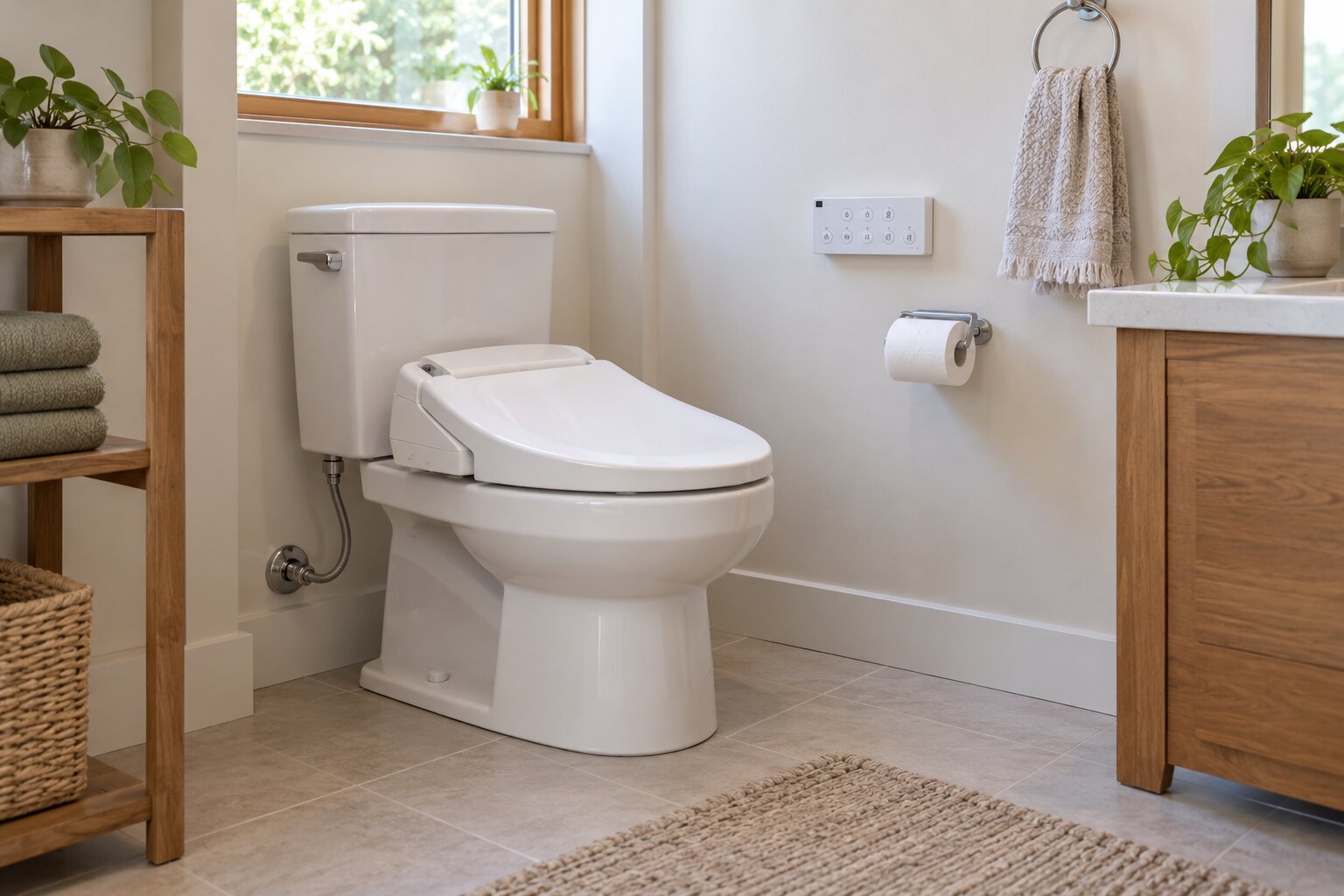
For a bidet, check bowl shape, fixing spacing, water connection and local backflow requirements. Electrical models need a suitable supply and appropriate installation. Check the final seat height, control reach and cleaning method with the exact model, not a generic product photograph.
Document the comparison
Record model, installed seat height, footprint, controls, installation requirements, warranty and full quote. The US ADA toilet-room guide is a contextual reference, not a best-product ranking. This guide contains no hands-on testing or top-five product claim.
Seat height and hygiene address different tasks
A replacement toilet or riser changes the sitting surface; a bidet changes washing. Assess each against the resident's transfers, foot support, reach and preferences. A wash function or dryer does not guarantee that wiping or assistance becomes unnecessary.
US ADA section 604.4 generally specifies 17–19 inches (430–485 mm) to the top of the seat, with a 15–19 inch residential-dwelling exception within its scope. Measure the installed seat, including a bidet or riser. Bowl-rim height alone cannot establish compliance.
Five product examples to investigate
These are documented examples, not tested rankings or individual recommendations. Exact model, regional availability, installed dimensions and professional suitability must be confirmed.
KOHLER Highline Tall K-22661 bowl
The manufacturer lists a 19-inch rim. Adding a seat can exceed the general ADA 19-inch finished-seat maximum. Do not assume “Tall” means ADA-compliant in the completed installation.
Check the manufacturer modelTOTO Drake II
TOTO's MS454124CEFRG specification distinguishes a 16⅛-inch bowl rim from the finished seat height. It makes compliance conditional on the installed seat, approach-side flush control and operating force. Confirm the exact regional model and seat combination.
Read the model specificationTOTO WASHLET C2 / C5
Check the manufacturer's compatibility chart for the precise bowl and WASHLET variant. Standard add-on seats and WASHLET+ combinations are distinct; concealed routing is not a feature of every pairing.
Check the compatibility chartBio Bidet USPA 6800U
The manufacturer lists warm-water washing, a heated seat, warm-air dryer and wireless remote. Check bowl size, control usability and support in your country. Dryer performance and personal suitability need evaluation; do not assume this replaces all assistance.
Check features and fitToilevator base riser
The supplier brochure describes a 3.5-inch height increase under the toilet base. Confirm footprint, connections, installed height and fitting instructions. This requires removing and reinstalling the toilet; it is not automatically suitable for unusual plumbing or every resident.
Read the supplier brochureCompare installation and ongoing use
Replacement toilet or base riser
Include plumbing connections, supports, floor condition, making good and final seat height in the quote. Compare transfer performance through assessment rather than a promised joint angle or a diagnosis-based product recommendation.
Electronic bidet seat
Use the exact installation manual for voltage, protective devices, outlet placement and circuit requirements. Outlet distance and whether a dedicated circuit is needed depend on the model and applicable rules. A qualified installer should confirm local bathroom electrical requirements.
Mechanical attachment
Check the permitted water connection, backflow protection, control reach and interaction with the seat. Washing, drying and power requirements differ from an electronic seat.
Raised seats and support equipment
Check compatibility of the complete arrangement. Do not stack a bidet seat, riser or support frame unless their manufacturers expressly permit it. Select support rails and transfer arrangements through individual assessment.
Plan together
For residents and families
Record the task, resident preferences and constraints, then discuss options with an individual assessor.
For contractors and professionals
Confirm assessed needs, manufacturer instructions and local requirements before specifying work.
Return to the room-by-room planning checklist
Sources & further reading
Sources reviewed 7 October 2026. No hands-on product testing or professional certification is claimed. US standards are contextual references, not universal private-home rules.
Turn this guide into a plan
Choose the next step that fits your project. These tools help prepare a discussion; they do not replace an individual assessment.